


May 4, 2026
In this blog, you will learn who is eligible for Duke Energy’s PowerPair program, how the program works for Duke Energy Carolinas customers, what it means that Cohort B is closed, and why Cohort A may still offer a path to the full PowerPair incentive and Battery Control participation later on.
Duke Energy Carolinas PowerPair update
For homeowners in Duke Energy Carolinas territory, PowerPair remains one of the most important solar plus battery incentives in North Carolina. The challenge is that capacity is limited, and the structure of the program matters more now than ever.
Duke Energy Carolinas customers may still be able to join PowerPair if they meet the rules and if there is still space left in the program. Cohort B is now closed, but that does not mean the whole program is gone. Some customers may still be able to join through Cohort A. After 24 months, they may be able to switch plans and join Battery Control later, depending on Duke’s rules and whether the program is still open.
That means this is no longer just a question of whether PowerPair exists. It is a question of which path is still open and how homeowners should think about timing.
Who is eligible for PowerPair
PowerPair is not open to everyone. To qualify, the customer must be a homeowner and a Duke Energy customer in North Carolina, either in Duke Energy Carolinas or the now-at-max-capacity Duke Energy Progress territory. The home must install solar panels and battery storage together at the same time, and the project must be completed by a Duke Energy Trade Ally. The customer must also provide internet connectivity for monitoring and must stay enrolled in the applicable rider for a minimum period under the program rules. Learn more by visiting powerpair.solar.
The incentive itself can total up to $9,000, made up of $0.36 per watt-AC for solar up to 10 kW-AC and $400 per kWh for battery storage up to 13.5 kWh.
For most homeowners, the main point is simple. PowerPair is designed for new solar plus battery installations, not solar-only and not battery-only. If the customer is planning to add storage later to an existing solar system, that does not fit the normal structure described in the current program materials.
How the full PowerPair program works
The program works in stages. First, the homeowner confirms eligibility and works with a Trade Ally on a solar plus battery design. Then the application is submitted to Duke Energy. If accepted, capacity is reserved, which is a critical milestone because PowerPair is first come, first served and incentive space is limited. After that, the system is installed, inspected, and activated. Final paperwork is submitted, and Duke Energy completes its review before finalizing the incentive.
One of the most useful details for homeowners is that once the application is accepted, the project is not expected to be installed immediately the next day. In one accepted PowerPair example, the customer’s application was approved in early January, capacity was reserved, and the project had until early October to complete installation and final documentation.
That matters because it means getting accepted into the program is really about locking in your place while capacity is still available.
What it means that Cohort B is closed
This is where many homeowners get confused. Hearing that Cohort B is closed can sound like the whole Duke Energy Carolinas opportunity is over. That is not necessarily the case.
Based on current internal PowerPair references, DEC Cohort B was essentially full as of mid-March 2026. At the same time, Duke Energy Carolinas overall was still projected to have remaining program capacity for a limited period.
That creates a more nuanced situation. Cohort B may no longer be the path for new DEC applicants, but Cohort A can still matter. For the homeowner, this means there may still be a route into PowerPair that preserves the one-time incentive now, even if the Battery Control rider is not the immediate enrollment path.
How Cohort A can still create value
This is the section many customers will care about most. If a DEC homeowner can still enter through Cohort A, that may still allow them to secure the up to $9,000 one-time PowerPair incentive today. Then, under the program terms summarized in Renu’s reference material, homeowners must maintain the initial rider enrollment for at least 24 months before switching, and they may switch eligible riders up to two times during the 10-year enrollment period. After 24 months in the initial rider, homeowners may switch to the Net Metering Bridge Rider or Residential Solar Choice, subject to availability.
That is why Cohort A still matters. Even if a customer cannot enter Battery Control through Cohort B today, they may still have a long-term path that looks like this:
Start in Cohort A.
Secure the one-time PowerPair installation incentive.
Maintain the initial rider for 24 months.
Then evaluate a switch to the rider tied to Battery Control, if program terms and availability still allow it.
This should be explained carefully because it is not the same as saying every customer will automatically receive Battery Control later. The more accurate message is that Cohort A may still preserve the upfront incentive now and create rider flexibility later under the program’s switching rules.
The DEC capacity update
The latest DEC capacity trend tells an important story:
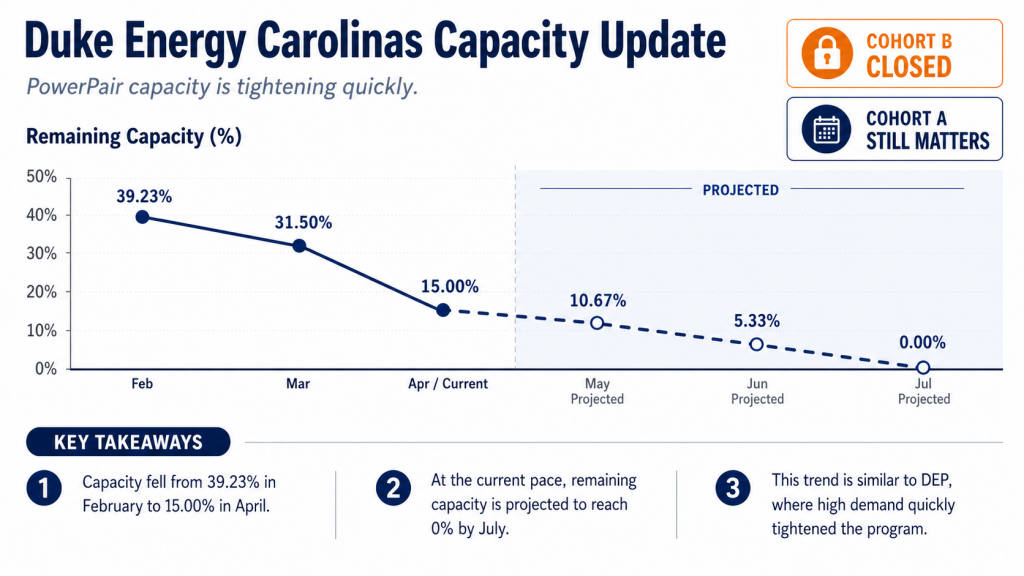
That is a steep decline in a short period. In practical terms, Duke Energy Carolinas moved from nearly 40% remaining capacity in February to only 15% remaining by April, with projections showing a path to full capacity by July.
This is exactly why timing matters. Homeowners who wait too long may not just miss Cohort B. They may miss the ability to reserve any remaining DEC PowerPair capacity at all.
What Battery Control offers later
For customers who do eventually move into Power Manager Battery Control, the value goes beyond the one-time installation incentive. Current PowerPair references say Battery Control can provide up to $52 per month for a single battery or up to $92 per month for a multi-battery setup. Duke Energy may remotely control enrolled batteries during grid events, with a minimum of 30 and up to 36 events per year, while the homeowner still maintains stored energy for household use.
That is why the Cohort A path matters strategically. Even if a homeowner cannot start in the Battery Control pathway right now, there may still be long-term value in getting into PowerPair while DEC capacity remains and evaluating the rider switch later.
Why timing matters now
The clearest takeaway is that waiting can complicate the opportunity. PowerPair is first come, first served, and accepted applications reserve capacity. Duke’s public PowerPair page says enrollment is first come, first served and that customers should apply as soon as possible after installation because capacity is limited and incentives are not guaranteed.
Internal references add more urgency for DEC specifically, showing that Cohort B is already effectively full and that overall DEC capacity is expected to keep tightening.
So for Duke Energy Carolinas customers, the decision is no longer just Should I look into PowerPair someday? It is closer to Can I still reserve a place through the path that remains open?
Closing thought
For DEC homeowners, the PowerPair conversation has changed. Cohort B being closed does not automatically mean the entire opportunity is over. Cohort A may still offer a path to secure the up to $9,000 installation incentive now, while preserving the possibility of moving into Battery Control later under the program’s 24-month rider rules.
That is why this moment calls for clarity. Homeowners need to understand not just whether PowerPair exists, but how the program works, which cohort paths remain open, and how capacity timing can affect the outcome.
Other Recent Posts
Jul - 2026
Feeling the Heat? How Carolina Homeowners Can Lower Energy Costs and Prepare for Storm Outages

Jun - 2026
250 Years of Independence, 250kW of Solar
May - 2026
Duke Energy Carolinas PowerPair Update: What DEC Customers Need to Know Now
Apr - 2026
How to Celebrate Earth Day with Solar, Battery Backup, and Clean Energy

Apr - 2026
Tesla Powerwall 3 Rebate Extended: How North Carolina Homeowners Can Combine It With PowerPair