

January 28, 2026
In this blog
In this blog, you will learn what the Duke Energy Carolinas PowerPair capacity chart is really saying, how it lines up with the best solar months in the Carolinas, and how PowerPair can work alongside other incentives like Duke’s battery control program.
PowerPair In A Snapshot
PowerPair from Duke Energy Carolinas is often talked about as one of the best solar utility incentives in the USA. It offers a significant one time credit to DEC customers who install solar plus battery storage and agree to let the utility use that battery in a controlled way during certain grid events. The key detail is that PowerPair is a capped pilot. Once the enrollment capacity is full, no more customers can receive that upfront incentive, even if they install the right equipment.
That is why capacity matters just as much as the incentive amount. If you wait until after the cap is reached, PowerPair is no longer on the table.
What The Capacity Chart Is Telling You
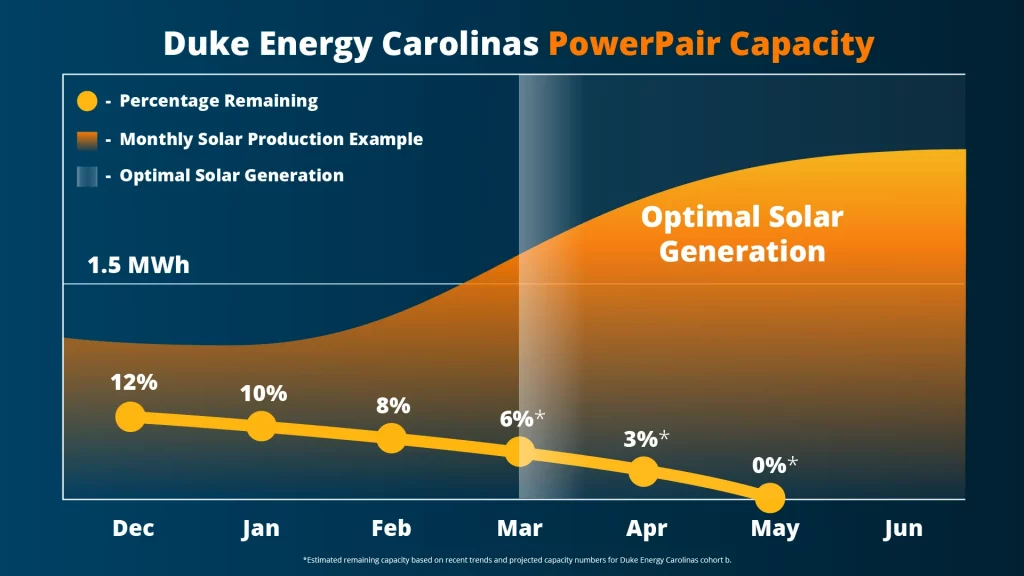
The chart you shared compares two things on the same timeline from January through July. The orange curve shows typical solar production in the Carolinas. Output is lower in winter, climbs in early spring, and reaches its strongest levels in late spring and early summer. The shaded band labeled “Optimal Solar Generation” highlights that peak window when days are long and the sun angle is high. This is when your system can deliver its best month to month performance.
Along the bottom of the chart, the yellow line shows estimated remaining PowerPair capacity for Duke Energy Carolinas. In January there is only a small portion of capacity left. By February and March, the remaining percentage shrinks even more. By April the line hits zero, which means the cohort is effectively full.
Put simply, the chart shows that PowerPair capacity is likely to run out just as the Carolinas enter the prime solar season. The months when your panels would be producing the most energy are the same months when PowerPair may already be closed to new participants.
Why Timing Matters For DEC Customers
Most people feel like thinking about solar when the weather turns nice and the sun feels strong. The capacity story for Duke Energy Progress shows why that instinct can backfire. In DEP territory, PowerPair capacity was reached in October. After that, new applicants were placed on a waitlist. Because demand stayed high, the waitlist itself had to close only about two weeks later. Homeowners who waited until the end of the year or until they saw more systems going up in their neighborhood found that both the program and the waitlist were already full.
Duke Energy Carolinas is following a similar capacity model. Once the remaining percentage of PowerPair space drops to zero for a DEC cohort, waitlists will fill up, and new projects can no longer receive the incentive. The chart below shows that this can happen right as the Carolinas enter the Optimal Solar Generation window, so waiting for perfect spring weather can mean missing the incentive entirely.
The good news is that once your PowerPair application is accepted, capacity is reserved and you have months to complete the installation. In one recent approval, the customer’s application was accepted in early January and the email confirmed that the system could be installed any time up to early October of that same year, as long as the final inspection and paperwork were submitted on time. That means the smart move is to secure your place in PowerPair while capacity is still available, even if your actual installation will not happen until later in the year.
How PowerPair, And Duke Battery Control Fit Together
Capacity is the main story, but it helps to know that PowerPair can sit alongside other programs. For many homeowners, the full value comes from stacking the different layers.
PowerPair is the anchor. It is the DEC incentive that reduces your upfront cost when you install solar and a qualified battery system and enroll in the program.
After your system is installed, Duke’s battery control programs and the Tesla Virtual Power Plant powered by Duke Energy can provide ongoing bill credits. If a customer opts into Cohort A, they can change cohorts after 2 years allowing access to the bill credits program. When you enroll, Duke can briefly use stored energy in your battery during high-demand events, and you receive regular credits for providing that capacity. Some PowerPair customers will be in a data-only group where the battery is monitored without dispatch, and others will be in a control group that receives those credits.
The details of each program are different, but the big picture is that a single solar plus storage project can benefit from PowerPair upfront and ongoing credits from Duke battery control. None of that changes the core issue shown in your chart. All of these benefits depend on getting in while PowerPair capacity is still open.
Where Renu Energy Solutions Comes In
Renu Energy Solutions tracks Duke Energy Carolinas PowerPair capacity and program changes closely and designs solar plus battery systems for homeowners across the Carolinas. We can look at where capacity stands today, how that lines up with your timeline, and how PowerPair and Duke battery control might apply to your specific project.
If you are a DEC customer and that capacity chart has your attention, a short conversation can help you understand whether there is still room in PowerPair and what it would take to have your system in place before the prime solar season arrives.
Other Recent Posts
Jul - 2026
Feeling the Heat? How Carolina Homeowners Can Lower Energy Costs and Prepare for Storm Outages

Jun - 2026
250 Years of Independence, 250kW of Solar
May - 2026
Duke Energy Carolinas PowerPair Update: What DEC Customers Need to Know Now

Apr - 2026
How to Celebrate Earth Day with Solar, Battery Backup, and Clean Energy

Apr - 2026
Tesla Powerwall 3 Rebate Extended: How North Carolina Homeowners Can Combine It With PowerPair