



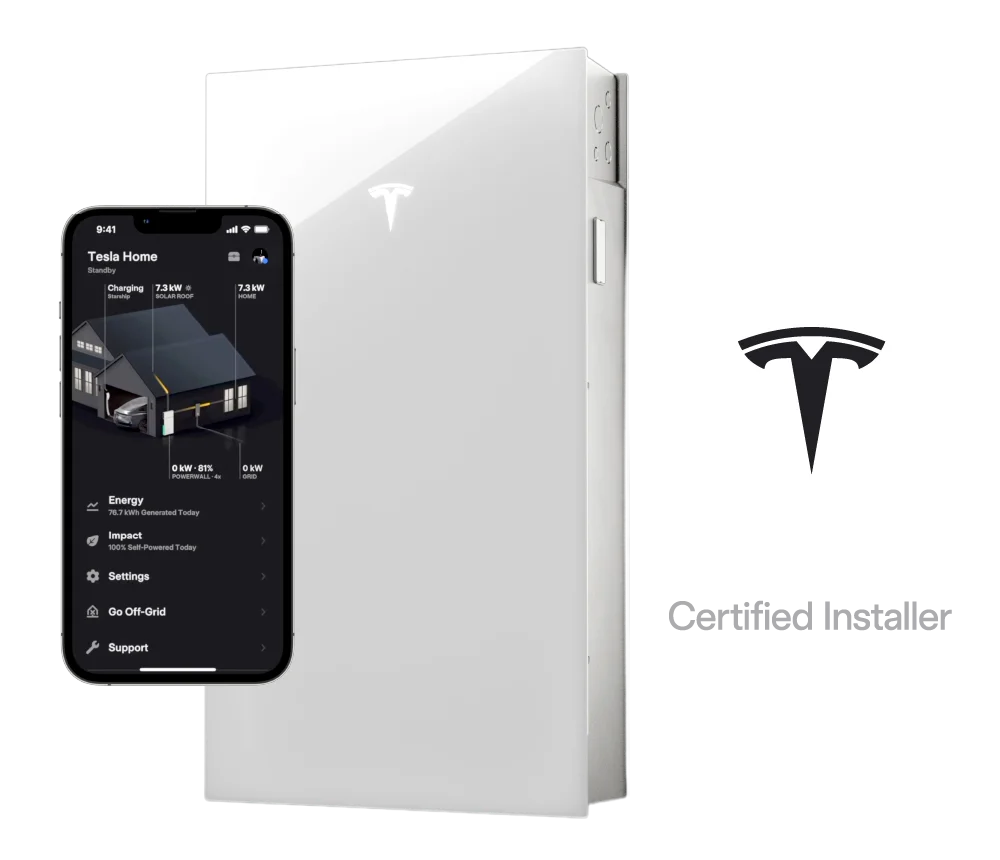
Tesla Powerwall 3 Installer
Store solar energy, lower your electric bills, and stay powered
during outages with a Powerwall 3 Battery Backup.
Tesla Powerwall Battery Benefits
Adding a Powerwall 3 battery to your solar energy system allows for true energy independence.
High Usable Capacity

10 Year Warranty
10 years of Tesla’s limited warranty guarantees long-term reliability, years of backup energy, and peace of mind.

Exceptional Peak Power
30 kW capable of managing high-demand surges from appliances and electronics, including HVAC.
The Powerful Tesla Powerwall 3 Battery
Renu Energy Solutions offers customized, no-obligation quotes for Tesla Powerwall 3 battery installations. Control where your stored energy gets used with advanced energy management with the Tesla App.
Get a Battery Quote
Renu does not sell your information to 3rd Parties.
"*" indicates required fields
Tesla Powerwall 3 Specifications
Usable Capacity: 13.5 kWh. Provides enough stored energy to keep essential appliances running during extended outages.
Continuous Power Output: 11.5 kW. Delivers consistent power for daily household use.
Peak Power: 30 kW. Handles short bursts of high energy demand, such as running HVAC systems or multiple appliances at once.
Battery Chemistry: Lithium-ion. Offers long life, high efficiency, and thermal stability.
Warranty: 10 years of Tesla’s limited warranty guarantees long-term reliability.
Check our FAQs to Learn More:
The Tesla Powerwall 3 (the current model as of 2026) features the following key specifications:
- Usable capacity: 13.5 kWh
- Continuous power output: 11.5 kW (more than double the Powerwall 2's 5 kW)
- Round-trip efficiency: 97.5%
- Battery chemistry: Lithium Iron Phosphate (LFP)
- Built-in solar inverter: Yes, supports up to 20 kW DC solar input
- Ingress protection: IP67 (flood-resistant up to 60 cm)
- Warranty: 10 years, unlimited cycles, guaranteed ≥70% capacity retention
Expandability: Up to 4 units (54 kWh total)
The Tesla Gateway 3 is the intelligent control center of your home energy system. While the Powerwall stores electricity, the Gateway manages how and when that energy is used. Think of it as the "brain" of the system. It interfaces with your home's electrical panel, monitors the grid, and automatically activates backup power when an outage is detected.
When a power outage occurs, Gateway 3 automatically disconnects your home from the grid and activates backup power from Powerwall 3 in less than a second. It also enables Smart Load Management, prioritizing energy use across appliances, and provides enhanced diagnostics through the Tesla app. Gateway 3 is required for all new Powerwall 3 installations.
This is a common debate on Reddit and solar forums. Experienced reviewers generally advise that buying through a Tesla Premier Certified Installer like Renu Energy Solutions can be significantly cheaper than ordering directly from Tesla, and also gives you the ability to choose panels with better labor warranty terms.
However, buying directly from Tesla can be advantageous if you want simplicity and a single point of accountability. The recommendation from experienced forum members: "If buying directly with Tesla, I would only do it if you have a dedicated local Tesla field team in your area." Always get multiple quotes from both Tesla and certified third-party installers before committing.
The Powerwall 3 is a significant upgrade over the Powerwall 2, with key improvements across power, efficiency, chemistry, and design:
- Power output: Powerwall 3 delivers 11.5 kW continuous vs. Powerwall 2's 5 kW, enabling large appliances, AC, and EV charging simultaneously.
- Battery chemistry: Powerwall 3 uses LFP (longer lifecycle, better thermal stability, no cobalt); Powerwall 2 uses NMC.
- Built-in solar inverter: Powerwall 3 includes an integrated inverter (up to 20 kW DC solar). Powerwall 2 requires a separate external inverter.
- Efficiency: Powerwall 3 achieves 97.5% round-trip efficiency vs. 90% for Powerwall 2.
- Compatibility: Powerwall 2 and 3 are NOT compatible within the same stack in most markets (backward compatibility is coming to AU/NZ in 2026).
For most homeowners starting new solar installations in 2026, the Powerwall 3 is the clear choice.
The installation process begins with a site assessment by a Tesla Advisor or certified installer like Renu Energy Solutions. After placing an order, Tesla or Renu Energy Solutions will pull the necessary permits, procure equipment, and schedule installation. The installation itself typically takes one to two days for a standard residential setup, though permitting timelines can add several weeks to the overall project.
During installation, the Powerwall is mounted on a wall (indoor or outdoor) and connected to your home's electrical panel. If you have an existing solar system, Renu Energy Solutions will integrate the Powerwall with it. For Powerwall 3, the integrated inverter replaces a separate solar inverter for new solar+storage builds, simplifying the system considerably.
After installation, the system must pass inspection by the local utility or authority having jurisdiction (AHJ) before it can be activated. Tesla's team will complete final commissioning and connect your system to the Tesla app.
The Powerwall 3 can be installed indoors or outdoors and is rated IP67 (flood-resistant to 60 cm). It must be mounted on a structurally sound wall with sufficient clearance for ventilation and service access, and kept out of direct sunlight for optimal performance. The Powerwall cannot be installed in living spaces or areas where flammable vapors may be present.
Local code requirements vary significantly. Some counties, particularly in California, have strict setback rules (e.g., a required 5-foot clearance from windows or doors) that can complicate placement decisions. Renu Energy Solutions will conduct a site assessment to determine the best location based on your local codes and available space.
Yes. Adding Powerwall to most existing solar installations is possible, though the configuration depends on your current inverter setup. When adding Powerwall 3 to an existing AC-coupled system (where the solar already has its own inverter), the Powerwall connects on the AC side and is limited to 7.68 kW AC per Powerwall within the backup circuit. For a new DC-coupled install (using Powerwall 3's built-in inverter), the system can handle up to 20 kW DC.
Contact Renu Energy Solutions, a Tesla Certified Installer, to assess your existing system. In some cases, older inverters may need to be replaced or supplemented to optimize performance with the Powerwall 3.
Yes. Powerwall can be integrated with a backup generator via an external Automatic Transfer Switch (ATS) or Manual Transfer Switch (MTS). The generator turns on only when the Powerwall charge is critically low or when loads exceed Powerwall's maximum continuous output. When grid power returns, the generator turns off and the Powerwall system reconnects and resumes normal operation.
Important limitation: the Powerwall does not charge directly from the generator, only from solar or the grid. During a prolonged outage, if the generator is running but the Powerwall is depleted, you will rely on the generator alone until solar production resumes charging the Powerwall.
Tesla has confirmed that Powerwall 3 + Powerwall 2 backward compatibility is in development, which will allow combined operation of Powerwall 2, Powerwall 3, and Powerwall 3 Expansion units together. Australia and New Zealand are confirmed to be the first markets to receive this software update (announced March 3, 2026). A timeline for other markets has not been officially confirmed.
Currently, in most markets, Powerwall 2 and Powerwall 3 cannot be stacked together. If you own a Powerwall 2 and want more storage, your options are: (1) find additional Powerwall 2 units (availability is decreasing globally as Tesla phases out the model), or (2) replace your existing system with Powerwall 3. Monitor Tesla's release notes for when the compatibility update arrives in your region.
The Powerwall offers three primary operating modes, all configurable through the Tesla app:
- Self-Powered Mode: The Powerwall charges from solar and prioritizes discharging to power your home before drawing from the grid. Maximizes use of self-generated solar energy. You can set a Backup Reserve percentage to ensure some charge is always available for outages.
- Time-Based Control Mode: The Powerwall charges and discharges based on your utility's time-of-use (TOU) pricing — storing cheap off-peak energy and discharging during expensive peak hours. Most effective in markets with significant TOU price differentials.
Backup-Only Mode: The Powerwall retains its full charge as a backup reserve and only discharges during a grid outage. Provides maximum outage protection but does not reduce electricity bills during normal operation.
Storm Watch is a feature that monitors weather forecasts for your home's location and automatically charges your Powerwall to maximum capacity when a severe weather event (like a hurricane or major storm) is predicted nearby. This ensures you have maximum backup energy available before a potential grid outage, even if you normally run with a low backup reserve to maximize daily savings.
When Storm Watch activates, you receive a push notification in the Tesla app. To enable: open the Tesla app, go to Settings > Storm Watch and toggle it on. Prerequisites: your phone must be paired with your Powerwall and Grid Charging must be enabled. The system uses your home location (verify in Settings > My Home Info) to determine if a weather event is approaching.
The Backup Reserve is the minimum charge percentage the Powerwall maintains at all times, ensuring energy is always available for a power outage. You set it as a percentage slider in the Tesla app. For example, a 20% reserve on a 13.5 kWh Powerwall holds 2.7 kWh in reserve at all times.
Setting a higher reserve (50–100%) prioritizes outage protection but reduces energy available for daily savings. A lower reserve (10–20%) maximizes daily savings. Storm Watch will automatically override your reserve setting and charge to 100% when a severe weather event is predicted, then return to your normal setting afterward.
The right number depends on your daily energy consumption, solar system size, and backup goals. Tesla's general guideline is one Powerwall per 7 kW of solar output as a minimum baseline. For Powerwall 3 (with its built-in inverter), one unit can handle up to 20 kW DC of solar input, though 14–15 kW is recommended to avoid production "clipping."
For whole-home backup during outages, most households with average consumption (30–50 kWh/day) benefit from two Powerwalls. If you plan to charge an electric vehicle from your Powerwall, experienced users strongly recommend getting as many Powerwalls as your budget allows. EV charging can quickly deplete even two units overnight. In most cases, two Powerwall 3s can handle a central AC or ductless mini-splits simultaneously, given their 11.5 kW continuous output per unit.
The average lifespan of a Tesla Powerwall is approximately 20 years, though this varies with usage patterns and environmental conditions. With careful daily cycling and proper maintenance, some units may last 25+ years. The Powerwall 3's LFP battery chemistry is inherently more durable for daily cycling than the older NMC chemistry in Powerwall 2.
Tesla's 10-year warranty guarantees that the battery will retain at least 70% of its original capacity by the end of the warranty period. After 10 years, you may notice some capacity degradation but the system should continue to function. Since capacity declines gradually, performance reduction is barely noticeable year-to-year.
The Powerwall 3's LFP chemistry performs better in extreme temperatures than older NMC batteries. The unit is rated for operating temperatures from -20°C to 50°C (-4°F to 122°F). In very cold climates, battery capacity may temporarily decrease. Lithium batteries deliver slightly less usable energy in freezing condition, but the system includes thermal management to maintain safe operation.
Solar production is naturally reduced in winter due to shorter days and lower sun angles, which means the Powerwall may charge less fully during winter months. In regions with heavy snow, keeping panels clear is important for maintaining generation. Net metering credits earned during summer can help offset higher winter grid usage in many states.
Enrollment varies by program. In most cases, eligible owners can sign up directly through the Tesla app (look for "Demand Response" or "Virtual Power Plant" options in Settings or the Energy tab). In some programs, enrollment is through a Tesla partner such as your utility or a certified installer.
General eligibility requirements typically include: having a Powerwall that is online and connected, living within the program's service territory, and having Grid Charging enabled. Some programs (particularly ConnectedSolutions in Massachusetts and Rhode Island) have limited enrollment windows or caps, so it is worth checking enrollment status proactively each year.
Payback periods vary based on your electricity rates, time-of-use pricing, net metering policy, outage frequency, solar system size, and usage patterns. With the expiration of the federal ITC in 2026, payback periods have lengthened compared to prior years. Current industry estimates put the typical payback at 8–12 years for a combined solar + Powerwall system.
In states with favorable net metering and high electricity rates (Massachusetts, New York), paybacks can be as short as 6–8 years. In areas with low utility rates and full net metering, paybacks may extend to 12–15 years. The system also provides significant resilience value (backup power) that is not captured in pure financial calculations — many homeowners find the peace of mind alone worth the investment.
Net metering policies determine how much credit your utility gives you for excess solar energy exported to the grid. In states with full retail net metering, exported solar earns a credit equal to the retail electricity rate. In these states, a Powerwall's primary financial value is backup power, since you can "store" energy virtually on the grid at full value.
In states with reduced net metering, like California's NEM 3.0, which pays significantly below retail rates for exports, storing energy in a Powerwall and consuming it yourself is far more valuable than exporting it. The Powerwall allows you to capture the full retail rate value of your solar production by avoiding grid purchases during expensive peak hours. This policy shift is one primary reason battery storage adoption has accelerated in California despite high upfront costs.
Tesla announced that the PowerShare with Powerwall feature, allowing Cybertruck owners to use their vehicle as a backup power source integrated with their Powerwall, has been delayed and is now scheduled for release in mid-2026. Tesla stated: "This new release date gives us additional time to design and test this feature, ensuring its ability to communicate and optimize energy" between the vehicle and the home battery system.
Cybertruck owners who planned their purchase or solar build around this feature should plan for the mid-2026 timeline. Currently, PowerShare can be used as a standalone vehicle-to-home (V2H) feature without a Powerwall, but full integration with the Powerwall ecosystem requires the pending software update.
Why Renu Energy Solutions?
Why Renu Energy Solutions?
Why Renu Energy Solutions?
Why Renu Energy Solutions?
- In-house employee (W2) installers.
- Over 600 5-star Google Reviews.
- NABCEP Certified Employees.
- Over 6,000 Solar Installations in the Southeast.
- Over 1,500 Energy Storage installations.
- Licensed General Contractor.
- Licensed Electrical Contractor.
- Turn-key Solar, Energy Storage, and Generator Installer.
Over 6,000 Solar Installations in the Southeast.
Over 1,500 Energy Storage installations (Tesla, Enphase, FranklinWH).
- Over 600 5-star Google Reviews.
In-house employee (W2) installers, not sub-contractors.
- Licensed General Contractor.
- Licensed Electrical Contractor.
- NABCEP Certified Employees.













Harness The Power of The SUN

Solar for Home
Renu will custom design your solar system to fit your energy goals, usage, and budget.
Energy Storage
Solar plus energy storage allows you to make your own power where you use it.


Commercial Solar
Save money and maintain productivity by investing in solar for your business.